
Trauma
What is Trauma?
Psychological trauma is a broad umbrella term for the negative psychological impact that can result from experiencing situations that are too overwhelming to cope with. Trauma can come about as a result of one big incident such as being involved in an accident or a sexual assault, or many incidents experienced over time such as being bullied, neglected or abused. It can also come through witnessing harm to others. It usually involves a violation of our core need of safety, whether that is attachment-based or physical, and can lead to psychological disorders such as Post Traumatic Stress Disorder (PTSD) or Complex Post Traumatic Stress Disorder (CPTSD). PTSD can occur as a result of a single-event trauma, whereas CPTSD tends to follow more chronic violations of safety over time, such as abuse or neglect.
Straight after experiencing or witnessing a traumatic event, we may notice symptoms such as shock, numbness, confusion or distress. These symptoms are normal reactions to abnormal events and can often resolve on their own, especially if there is an opportunity to share the experience and to be supported by friends and/or family after the event. However, if these symptoms do not resolve after a month or so, it may be that you need some help with processing the trauma.
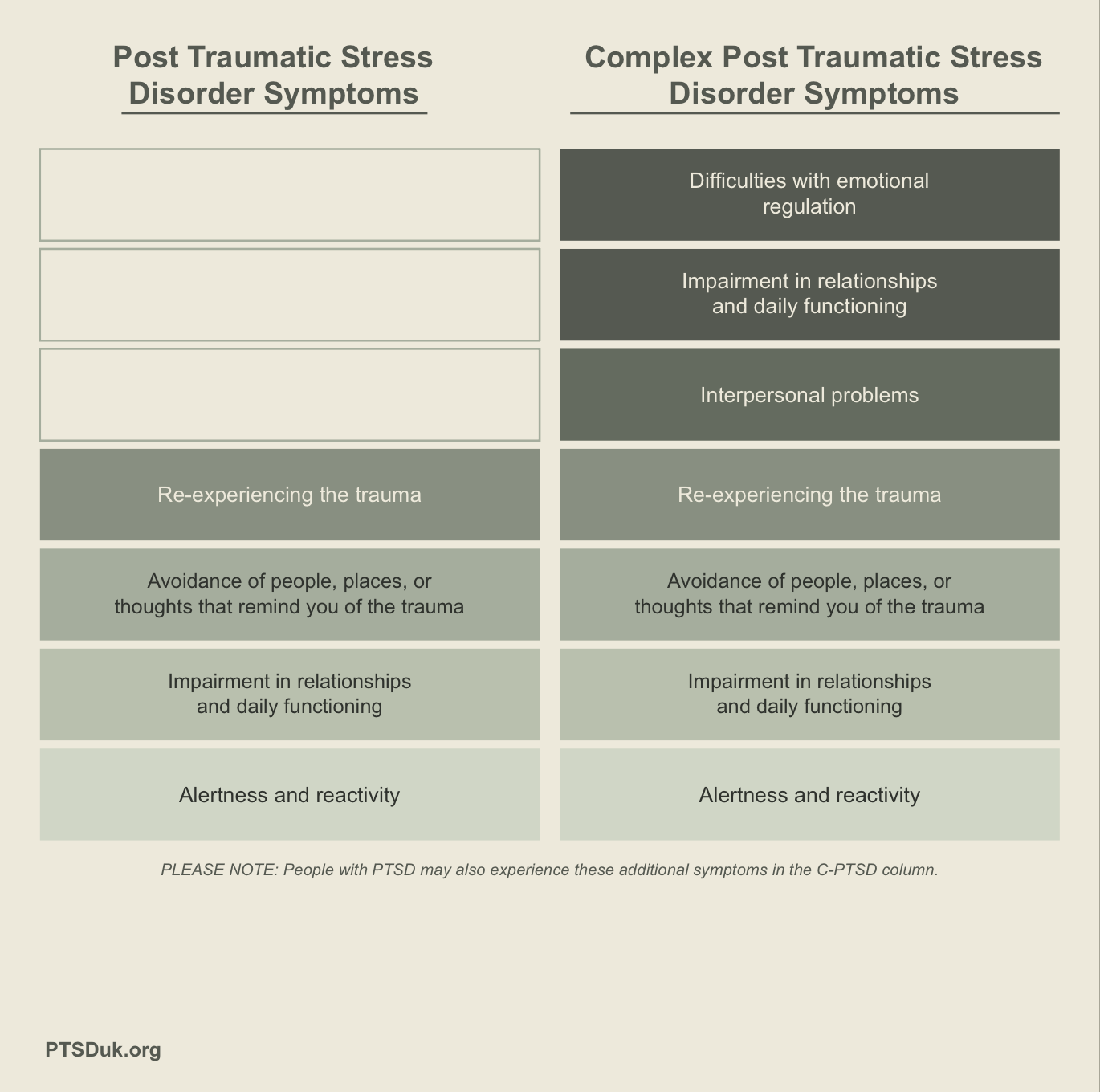
PTSD symptoms include 4 main clusters:
Re-experiencing: which can make you feel like you are reliving the traumatic experience(s) again in the present. These include visual or emotional flashbacks, nightmares, and intrusive memories.
Avoidance: Attempts at suppressing the memory of the event, avoiding thinking or talking about what happened, or reminders such as people or places associated with the event.
Negative changes to the way you think and feel about yourself, others and/or the world, and emotions that are not resolving naturally – such as shame, guilt, anger, or fear. It may be difficult to remember the event properly. Mood can be low and you may feel detached from the people you are close to, or find yourself withdrawing from people and activities you value. Another symptom is feeling numb. You may be experiencing dissociation as a result of the trauma you have experienced, whereby you may feel removed from yourself and/or your surroundings.
Being more emotionally or physically reactive. You may notice that you have more of a startle reflex, or that you are scanning for danger all the time. You may feel irritable, angry or aggressive or find it harder to concentrate or sleep. Some people notice that their hearts are beating more rapidly or that they are sweating a lot more than usual.
You may notice that everyday features of life may trigger symptoms. For example, if you were involved in a road traffic accident, you may feel like you are reliving the emotional/physical experience of your accident when you hear the sound of screeching brakes. This can make people feel very out of control and like they are going crazy, however, it is just due to how the brain has stored away core features of the memory. Trauma-based memory tends to be more sensory in nature than normal memories, and so sensory reminders can bring back intense re-experiencing of the event. PTSD can be treated successfully with psychology therapy.
Complex PTSD:
C-PTSD shares the same 4 core clusters of symptoms as above but also some other symptoms due to the recurrent nature of the trauma experienced, or the longer time span of the trauma. These extra symptoms are:
Low self-worth: chronic trauma is often personalised, whereby the person affected may blame themselves, feel that the abuse/neglect means something about their worth as a person, and may feel intense shame or guilt as a result
Relationships might feel difficult: it may feel difficult to trust people leading to avoidance of establishing relationships, or maybe it feels too difficult to establish a healthy relationship with boundaries, leading to connections that are too intense.
Emotion dysregulation: emotions may feel very out of control at points or feel like they escalate suddenly. This is sometimes accompanied by attempts to regulate or numb such as self-harm, substance misuse, or overeating, amongst others. Sometimes this can also lead to risky behaviours.
How are trauma, PTSD and CPTSD assessed?
Trauma is assessed via an initial consultation, through taking a life history and also speaking about recent events, current lifestyle, and the difficulties you are facing. This allows a shared understanding of the origins of the trauma as well as the natural coping mechanisms that may inadvertently be maintaining the disorder. PTSD and CPTSD are further assessed via measures such as the PCL-5 and the International Trauma Questionnaire. Measures such as these allow us to get a sense of the extent of the difficulties and help us track how well our treatments are working.
What therapies we use and why?
The National Institute for Health and Care Excellence (NICE) and the World Health Organisation (WHO) recommend two gold standard treatments for PTSD:
Trauma-Focused Cognitive Behaviour Therapy, also known as TF-CBT. All of the therapists here are trained to use this both with children/adolescents and adults.
Eye Movement Desensitization Reprocessing therapy (EMDR). Alison is fully trained in this approach, and Sara has undergone initial training and can also use this approach as part of her treatment, when appropriat
Some therapists here are also trained in Dialectical Behavioural Therapy for Complex Post Traumatic Stress Disorder (DBT-CPTSD), which is an evidence-based structured 45 session therapy for those who are experiencing distress as a result of chronic trauma.
What does a typical course of treatment look like?
Typically for PTSD, it is recommended to begin with 8-12 sessions, unless more sessions are indicated because of things like having experienced multiple traumas, or having other mental health diagnoses. How treatment looks varies person to person, but TF-CBT tends to follow:
An assessment session which involves a history taking and description of current difficulties, discussion and goals, expectations and fears
Collaborative formulation of the difficulties – how they have arisen, how they are being maintained and a plan for how to recover
Orientation to the model being used, including psychoeducation around trauma, PTSD/CPTSD
Gentle introduction to stabilisation and grounding to ensure that you feel equipped to cope with exposure to memories of the traumatic events to help start processing
Work on the impact that the trauma may have had on your emotional and cognitive processing via engagement with core memories and updating based on what is known now. This also includes looking at things that may be maintaining inappropriate guilt or shame – such as hindsight bias or over-responsibility
Sometimes people are encouraged to revisit the site of the trauma, if it would be helpful – this may be in person or online.
Future planning – reclaiming your sense of yourself and getting back on course with what you want for yourself now and in the future.
However, treatment is very much adapted to suit the needs of the individual so may include other techniques as well.
What results you might expect?
Treatment is of course structured around your aims, but typically we would expect to see a very noticeable decrease in symptoms – to the point of no longer meeting the diagnostic criteria for PTSD. People often describe feeling as though they are more able to be in the here and now, no longer experience nightmares, and that the memories no longer bring up intense, uncontrollable emotions. We would aim to help you feel less stuck in the past and to feel hopeful and able to take steps towards a future you value.
In some situations, we may need to incorporate other types of therapies, such as compassion-focused therapy – particularly if self-criticism is acting as a barrier. And in other situations, EMDR or DBT-PTSD may be more appropriate or beneficial. Sometimes a combination of approaches is indicated and that has been helpful for many clients.
For extra information on trauma please see the following blogs as well as the resources page on our website:
Meet the therapists who can help
-
![]()
Emma Fowler
Psychological Therapist
Emma is warm and easy to talk to, creating a safe space where people feel comfortable exploring difficult feelings without judgement. She works alongside her clients, building on their strengths to help them find clarity and confidence.
-
![]()
Karyn McHale
Psychological Therapist
Karyn brings a gentle, empathic style built on genuinely listening and tailoring her approach to each person. Clients often find it easy to open up to her and leave sessions feeling heard and understood.
-
![]()
Alison Harper
Chartered Clinical Psychologist
With over 20 years of experience, Alison brings a warm, flexible approach that adapts to what each person needs. Clients describe feeling genuinely heard and leaving sessions with practical tools that make a real difference. -
![]()
Ashleigh Marsh
Psychological Therapist
Ashleigh creates a compassionate space where clients feel heard and actively involved in their own progress. Her focus is on helping people understand their difficulties and giving them real, practical tools to move forward. -
![]()
Dylan Keith
Psychological Therapist
Dylan takes a calm, collaborative approach, helping clients understand the connection between their thoughts, feelings and behaviour. He takes time to ensure each person feels supported and equipped to make lasting, positive change. -
![]()
Amy Grant
Trainee Clinical Psychologist
Amy brings over six years of therapeutic experience and a warm, inclusive approach that helps people feel genuinely heard and safe to explore what they are going through. She works collaboratively with each person, drawing on a range of evidence-based therapies to find what fits best for them.
-
![]()
Sara Huibregtse Van Loon
Psychological Therapist
Sara is known for her warm, collaborative style and her ability to tailor therapy to each individual. Clients consistently describe feeling understood and well-supported throughout their time working with her.







Frequently Asked Questions
-
In the short term, you may feel a spike in your emotions and an increase in symptoms, as you are starting to drop avoidance based coping mechanisms. However, this tends to just be temporary, and your therapist will have prepared you for how this might look and will have helped you to establish techniques to help you through this via the preparation phases. It is actually helpful to have access to the emotions associated with the trauma in order to help you process them.
Avoidance based coping is so normal in relation to PTSD symptoms, however we know that thought/emotion suppression does not actually work very well and so even though in the short term you may feel worse, it opens the door to moving through the stuck emotions and thoughts associated with the event.
-
Yes, of course – it is important that you feel comfortable with the treatment plan and that you feel you have control over the process. Please feel free to share any questions or concerns you have with your therapist. They will always keep your preferences at the centre of the treatment.
-
This varies, depending on the nature of the trauma. Treatments may also have different lengths, for example, trauma-focused CBT tends to be delivered over 8-20 sessions, whereas DBT for Complex PTSD comprises 45 sessions, and Eye Movement Desensitisation Reprocessing therapy (EMDR) does not have a set number of sessions per treatment. If trauma has been complex and relational, people often find they gain a lot from longer term therapy, however this is by no means required for everybody.
-
This depends on your goals, circumstances such as level of social support available and current lifestyle, and coping tendencies. For some people, revisiting the details of trauma is not helpful or tolerable and, in such cases, it can be more helpful to focus on improving life in the present. Your aims will always be discussed prior to any suggestions being made around the most suitable approaches. When a processing-based trauma therapy is used, your therapist will always incorporate a preparation phase which consists of grounding and stabilisation and ensure readiness for active processing whether that is through EMDR, CBT or DBT. They will communicate with you throughout so ensure you are comfortable to continue.
-
Often trauma treatment consists of a mixture of regular length (50 minute) and slightly longer (1.5 session length) appointments. This is to ensure that adequate time is provided for the sessions focused on processing of traumatic memories, so as to allow for a calm and grounded ending to the session, when required.
Please don’t hesitate to reach out to us to ask if you have any questions that are not covered here. We are very happy to provide any information you need.
More of What We Do
-
![]()
CBT / Psychological Therapy
-
![]()
EMDR
-
![]()
OCD
-
![]()
Anxiety
-
![]()
Depression
-
![]()
Chronic Pain
-
![]()
Health Anxiety
-
![]()
Low Self-Esteem