
Accepting yourself
Finding the Courage to Be the Person You Really Are
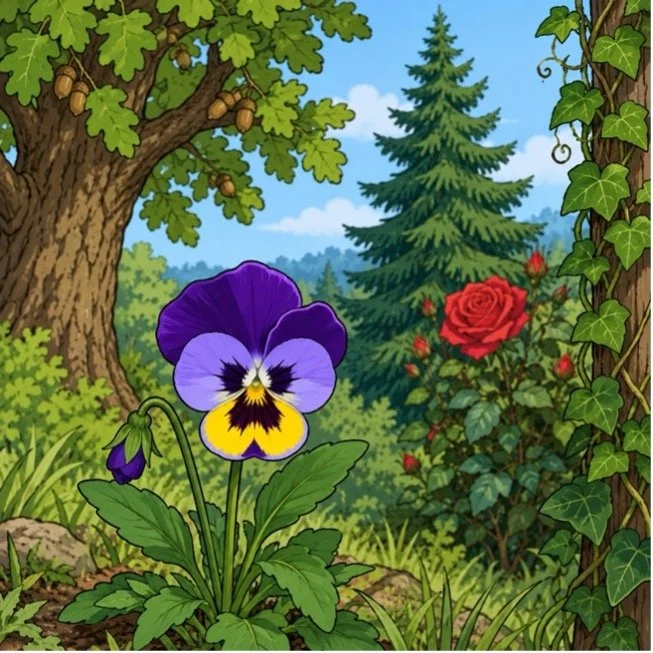
Wild pansy growing strong in a garden.
As a psychologist, I spend a great deal of time listening to people describe the person they believe they should be. They should be more confident. More successful. More sociable. Less sensitive. More attractive. Less anxious. More like their brother, their colleague, their friend, their parent, or the person they imagine everyone else has somehow managed to become. But underneath many of these struggles, I see the same painful question:
“Why can't I just be different?”
Psychological therapy often involves helping people change. We work on patterns of thinking, behaviour, and emotional responses. We help develop new skills and try to challenge unhelpful beliefs. But there is another psychological task that is sometimes just as important as change: learning to stop fighting the fundamental reality of who we are. And that’s where I think radical acceptance, a term coined by Marsha Linehan, can be really helpful. As she says:
“It’s a willingness to notice and accept things as they are right now, without judging."
Radical acceptance doesn’t mean giving up. It doesn’t mean deciding that everything about us is perfect, or that we should never try to change and develop. Nor does it mean accepting harmful behaviour or circumstances without attempting to change them. Instead, radical acceptance begins with something much simpler.
The story of the king’s garden…
This story brilliantly encapsulates the idea of radical acceptance:
"Once upon a time there was a king. One day the king went into his garden. And when he came into the garden, he found only withering and dying trees, shrubs and flowers. The king went to an oak tree and asked what had happened? The oak said it was dying because it could not grow as tall as the fir. When the king turned to a fir tree, it only let its branches hang, because it could not bear grapes like the vine. The vine was also dying because it could not blossom like the rose.
The king then discovered the wild pansy. The wild pansy was blooming and fresh as ever. The king asked the pansy why it was the only one not dying. To his question, he received the following answer: "It was clear to me that you wanted a pansy when you planted me. If you had wanted an oak, a vine or a rose, you would have planted an oak, a vine or a rose.
Therefore, I thought, since you planted me here, / should do my best to fulfill your wish. And since I can't be anything other than what I am, anyway, I'll try to be that to the best of my ability."
I love the response of the wild pansy. Whilst the others are all consumed by unhelpful comparisons, rather than seeing themselves as simply different to the others, the pansy seems to understand something that we can find extraordinarily difficult to remember: there is no prize for becoming someone you were never meant to be.
The psychological cost of comparison
In my clinical work, I see how easily comparison can become a “compare and despair” exercise. We rarely compare ourselves with another person in a neutral way. Instead, we tend to compare our internal experience with somebody else's external presentation. So, we see their confidence but not their insecurity, their achievements but not their disappointments, their composure but not the anxiety they may experience when nobody is looking. And then we look at ourselves from the inside and conclude that we are somehow falling behind. Social comparison can become particularly painful when it turns into identity comparison: "Why can't I be more like them?"
The difficulty is that this question often contains an assumption that there is something fundamentally wrong with us. Too quiet, too emotional, too “boring”, too needy. Perhaps I should have become somebody else by now. And, when these thoughts become habitual, we can spend enormous amounts of psychological energy trying to escape ourselves. The really sad thing is that we can become so preoccupied with becoming someone else that we never discover what it might mean to become more fully ourselves.
Radical acceptance is not resignation
I think the word acceptance can sometimes be misunderstood. A person might hear "accept yourself" and think, So I'm supposed to stop trying? But that isn't what I mean. Acceptance and change are not opposites. In fact, acceptance can be the beginning of meaningful change.
If I cannot accept that I am anxious, I may spend my life desperately trying to eliminate anxiety. Every anxious thought becomes evidence that something is wrong with me. I become frightened of being frightened. If I can accept, I am a person who experiences anxiety, I can begin asking a different question - Given that this is part of my experience, how do I want to live?” And that’s a much more productive question.
Similarly, accepting that I am introverted does not mean I can never challenge myself socially. Accepting that I am sensitive does not mean I cannot develop emotional boundaries. Accepting that I have made mistakes does not mean I cannot take responsibility and behave differently. Accepting my limitations does not mean I cannot work towards my goals. And accepting who I am today certainly does not mean I have to remain exactly the same tomorrow.
Radical acceptance simply removes the additional battle: "I shouldn't be like this." And it’s only then can I begin to work with reality rather than against it.
The difference between acceptance and self-indulgence
There is another important distinction. Radical acceptance is not an excuse to avoid responsibility. I can accept that I am easily angered while also acknowledging that hurting people when I am angry is not acceptable. I can accept that I have developed certain defensive behaviours while still working to change them. I can accept that something painful happened to me without deciding that what happened was okay. I can accept that another person may never give me the apology I want without approving of what they did.
Acceptance is about acknowledging reality. It is not the same thing as approving of reality. And this distinction is enormously important in psychological work because, when I accept something, I stop pretending that it is not happening – and that gives me a clearer starting point from which to decide what I want to do next.
What if I am not the person I thought I would be?
Perhaps one of the most difficult forms of self-acceptance comes when we encounter the gap between who we imagined we would become and who we actually are. Most of us carry some version of an imagined self. The person we thought we would be at thirty. The career we thought we would have. The relationship we thought we would be in. The personality we thought we would develop. The life we assumed would unfold. Sometimes the pain is not simply about what has happened. It is about grieving the person we thought we were going to become.
So, Radical acceptance can involve grief. It can mean saying: This isn't the life I imagined. I'm not the person I thought I would be. Some of the things I wanted may never happen. Those statements can be painful, but acknowledging them can also create space for another question: If this is the life I actually have, rather than the life I imagined, how do I want to live it? That is where acceptance becomes liberating.
You don't have to become the oak
The oak in the story doesn’t need to be taller. The fir does not need to produce grapes. The vine does not need to blossom like a rose. And the pansy does not need to apologise for being a pansy.
Whilst this seems obvious when we are talking about plants, it becomes much less obvious when we are talking about ourselves. Perhaps that’s because we live in a culture that constantly presents us with models of what a successful, attractive, confident, productive and fulfilled human being is supposed to look like. And so, it’s very easy to conclude that our own shape is wrong. But perhaps the more useful question is not: How do I become more like them? Perhaps it is:What does it mean to become the healthiest version of me?
Whilst the first question begins with comparison, the second begins with acceptance. And acceptance allows us to work with our actual characteristics rather than spending our lives fighting them.
There is still room to grow
In the story, the wild pansy's words contain something else really useful: I'll try to be that to the best of my ability. That is not passivity. It’s not: This is who I am, so nothing can change. It is: This is who I am. Now what can I do with that? And I think that this a much more compassionate and helpful approach to personal development.
We can acknowledge our temperament, our history, our vulnerabilities, our strengths, our limitations and our particular ways of experiencing the world. Then we can ask how we want to live within those realities. Perhaps I cannot become somebody who never worries, but I can learn to respond differently to worry. Perhaps I will never be naturally outgoing, but I can develop meaningful relationships. Perhaps I am highly sensitive, but I can learn to protect that sensitivity rather than treating it as a defect. Perhaps I have made choices I regret, but I can accept that those choices are part of my history while choosing differently now. Perhaps there are things about myself that I genuinely wish were different, but I can acknowledge that wish without turning it into hatred of myself. That, to me, is the heart of radical acceptance.
What happens when we stop trying to earn our right to exist?
Many people live as though they have to earn the right to accept themselves. I'll accept myself when I lose weight. I'll accept myself when I become successful. I'll accept myself when somebody loves me. I'll accept myself when I'm no longer anxious.
But this makes self-acceptance conditional. It turns acceptance into a reward that is perpetually somewhere in the future.Yet, from a psychological perspective, I find it more helpful to think: I can accept myself now and still want to change and develop. I don't have to hate myself into becoming a better person. I don't have to be ashamed of myself in order to take responsibility. I don't have to believe I am fundamentally defective in order to change. In fact, compassion often provides a more sustainable foundation for change than self-criticism.
Becoming fully yourself
When I think about the wild pansy, I don't think its lesson is that we should never change. I think its lesson is that our growth should begin with a recognition of who you are and where you are, what has shaped you, your strengths and your vulnerabilities. Then you can look at the parts of yourself that you would both like to change and that you can change. You need to make peace with the starting point. You can’t become an oak when you are a pansy – and you don’t need to either! You do not need to become a different person before you are deserving of kindness from yourself.
As a psychologist, I don't see acceptance as the end of psychological growth. I see it as the ground from which real growth can begin. Because when I stop asking, “How can I become somebody else?”, I can finally ask the more important question: How can I become more fully myself?” And perhaps that is what the little wild pansy understood all along. It was never trying to be something it wasn't. And perhaps, for many of us, there is freedom and contentment to be found in doing the same.